WHAT YOU ARE LOOKING AT
Business Insider identified these as Clair’s $11.6 million seed deck, redacted for public release, on July 5, 2026.
All 13 images appear unchanged and in public presentation order. The black bars are in the supplied slides. I separate what Clair says from what those claims prove. This is the redacted public deck; private investor materials are outside this record.
SLIDE 01 / 13
A breakthrough, declared
WHAT THE SLIDE SAYS
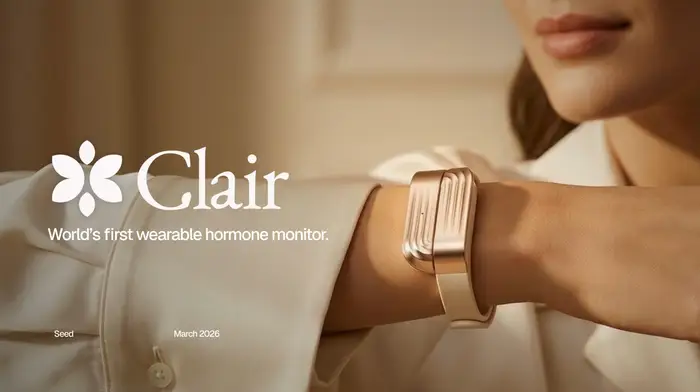
The cover calls Clair the world’s first wearable hormone monitor and carries a March 2026 date.
WHERE THE PITCH BREAKS
The breakthrough arrives in the headline. The proof has to arrive in the data. March 2026 is the cover’s date, not a verified last-revision date: the preorder chart later in this set includes April dates.
SLIDE 02 / 13
A big problem does not prove the solution
WHAT THE SLIDE SAYS
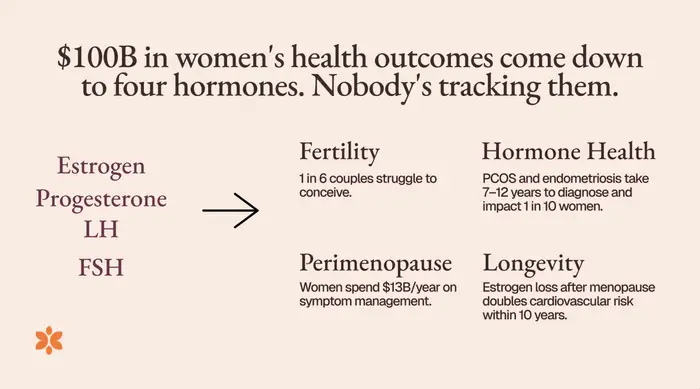
The slide invokes a $100 billion problem and names four hormones: estrogen, progesterone, LH and FSH.
WHERE THE PITCH BREAKS
A $100 billion problem makes a compelling pitch. It does nothing to demonstrate that this bracelet solves it. An unmet need is a reason to do the research. The device still has to pass the test.
SLIDE 03 / 13
A queue is not a clinical result
WHAT THE SLIDE SAYS
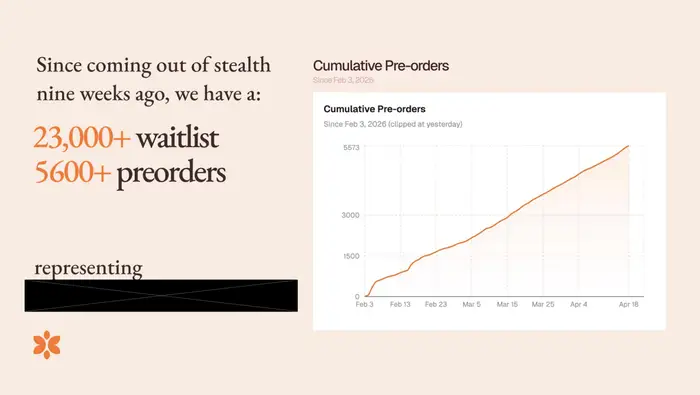
Clair reports 23,000+ on its waitlist and 5,600+ preorders, with a rising cumulative-preorder chart. The represented monetary value is blacked out.
WHERE THE PITCH BREAKS
A waitlist shows interest in the promise. A preorder count still needs payment, refund and cancellation terms; this slide supplies none. Neither number tells you whether the bracelet works. Demand cannot stand in for revenue or validation.
SLIDE 04 / 13
Read the word after “purchase”
WHAT THE SLIDE SAYS
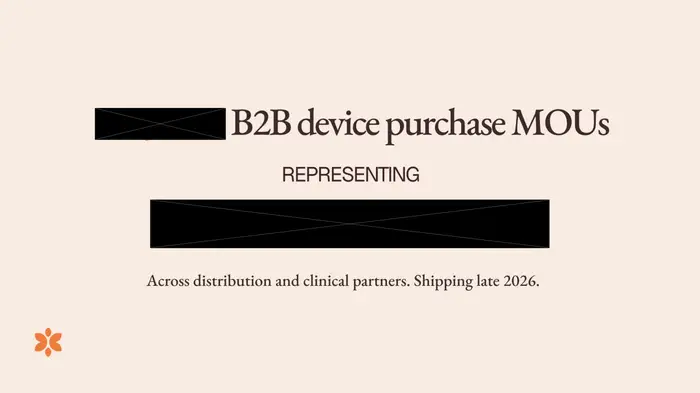
The company’s label is “B2B device purchase MOUs.” Both the count and represented value are redacted. The slide says shipping is planned for late 2026.
WHERE THE PITCH BREAKS
The slide says MOUs: memoranda of understanding. Read that before repeating the contracts headline. The label alone cannot establish what is binding or cancellable, or whether these are the agreements behind a16z’s $18 million claim. Show the terms.
SLIDE 05 / 13
Clinical partners. Letters of intent.

WHAT THE SLIDE SAYS
The deck describes a clinical-partner network ahead of a November launch, then introduces its list with “OUR LOIS INCLUDE.” The partner count and list are redacted.
WHERE THE PITCH BREAKS
LOIs are letters of intent. This slide pitches adoption and distribution, with the partner list blacked out. It supplies no completed clinical-validation result. A letter of intent cannot tell you how accurately a bracelet reads hormones.
SLIDE 06 / 13
Read the poster behind the publicity
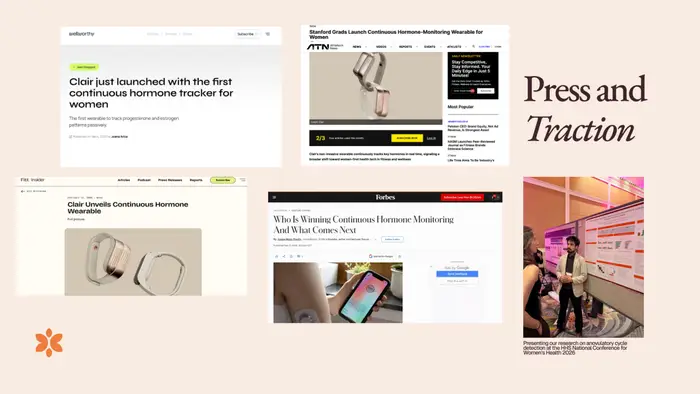
WHAT THE SLIDE SAYS
The slide assembles press coverage and a research-poster presentation under “Press and Traction.”
WHERE THE PITCH BREAKS
The poster is doing credibility work in this pitch. Read its methods. The separately supplied full poster photograph names mcPHASES data and Fitbit, Dexcom and Mira equipment: an analysis of existing recordings. It does not establish a trial of Clair’s production bracelet. The validation chapter follows those data back to their source.
SLIDE 07 / 13
The founders and the logo wall

WHAT THE SLIDE SAYS
The slide names the two cofounders and surrounds their biographies with recognizable institutional and company logos.
WHERE THE PITCH BREAKS
The logos are recognizable. What each organization actually did for this product is not explained here. An FDA logo is not an authorization document. A résumé can sell the founders; it cannot establish the bracelet’s accuracy.
SLIDE 08 / 13
A good time to sell the promise
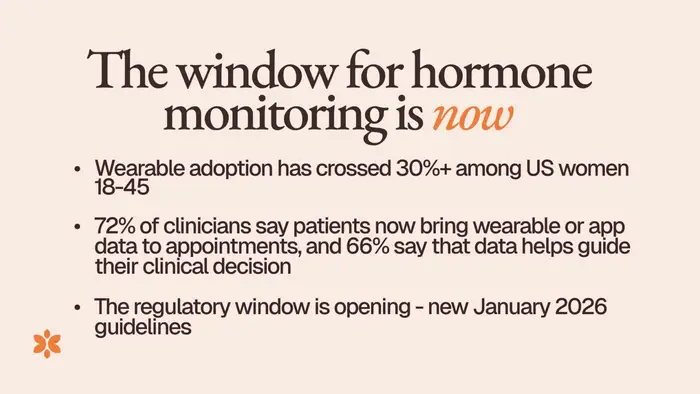
WHAT THE SLIDE SAYS
Clair argues that adoption, clinician interest and a changing regulatory environment make this the moment for hormone monitoring.
WHERE THE PITCH BREAKS
The slide argues that customers, clinicians and regulators make this the right moment. It supplies no performance results for Clair’s device. Perfect timing does not make a hormone reading accurate.
SLIDE 09 / 13
The ask is blacked out
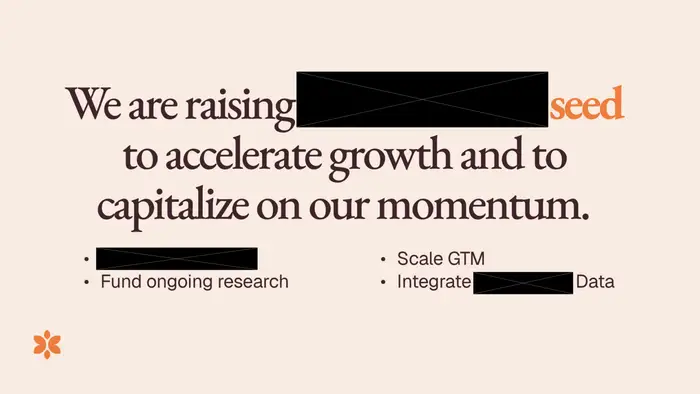
WHAT THE SLIDE SAYS
The fundraising amount is blacked out. Visible uses include funding ongoing research and scaling go-to-market; other text is partly redacted.
WHERE THE PITCH BREAKS
Ongoing research and scaling go-to-market appear on the same funding slide. The ask is hidden. This image establishes the visible proposed uses, not the amount requested, the final amount raised, or the research investors received privately. The redactions cannot answer those questions.
SLIDE 10 / 13
The appendix, kept intact
WHAT THE SLIDE SAYS
The divider is preserved as supplied.
WHERE THE PITCH BREAKS
The whole supplied set is here: all 13 images, including this divider. The order follows the public presentation. This reader preserves that record; it does not reconstruct an unredacted investor deck.
SLIDE 11 / 13
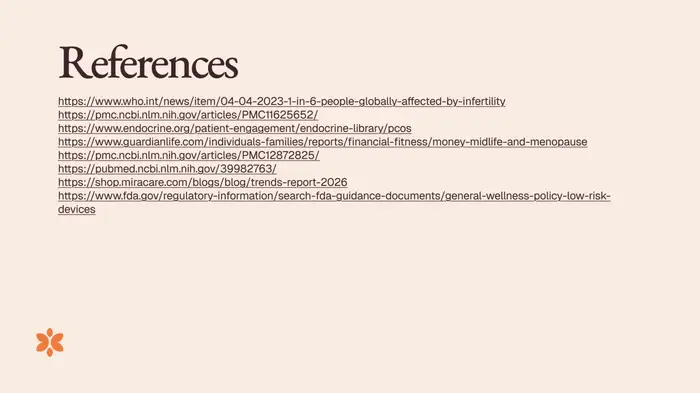
A bibliography. Where is the device study?
WHAT THE SLIDE SAYS
The deck supplies eight reference links. The original image preserves the URLs.
WHERE THE PITCH BREAKS
Eight links do not add up to a device-validation report. A references page cannot do the work of testing the bracelet. The listed pages were not all independently reviewed for this deck update, and this reader does not treat them as corroboration of Clair’s performance.
SLIDE 12 / 13
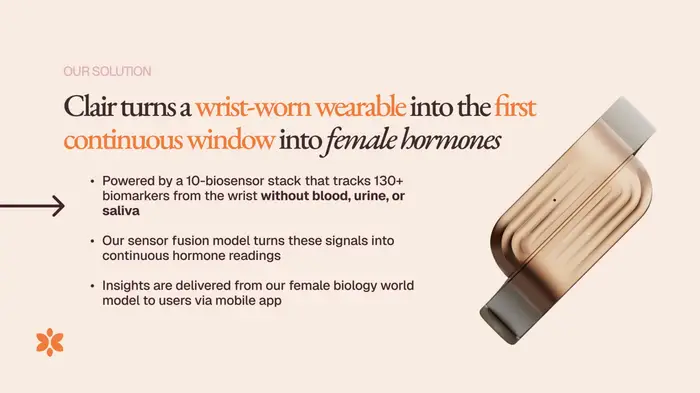
The leap is in the arrow
WHAT THE SLIDE SAYS
The solution slide promises a 10-biosensor stack tracking 130+ biomarkers without blood, urine or saliva. A sensor-fusion model turns those signals into continuous hormone readings.
WHERE THE PITCH BREAKS
Physiological signals go in. Continuous hormone readings come out. That arrow is the claim to test. Put the predicted hormone concentrations beside reference assays and show the errors. A diagram cannot do that job.
SLIDE 13 / 13
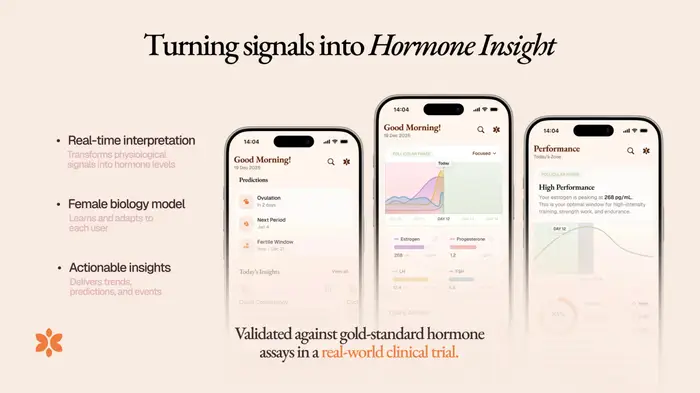
“Validated.” Show the validation.
WHAT THE SLIDE SAYS
The app screens include a numerical estrogen reading of 268 pg/mL. Beneath them, Clair claims validation against gold-standard hormone assays in a real-world clinical trial.
WHERE THE PITCH BREAKS
268 pg/mL looks precise. This slide gives the reader no trial identifier, participant count, hardware version or hormone-specific error results. An app screen is not an error analysis. These public slides are redacted, so their omissions do not establish what investors saw privately. Publish the report behind the claim.