Clair’s phase-classification score does not establish the accuracy of its promised hormone concentrations. The decimal point does not close that gap.
The decimal point is doing a lot of work.
Clair reported 94.1% accuracy at classifying menstrual-cycle phase. The same FAQ reported 87% sensitivity for detecting an LH surge. These are specific results for specific tasks. Neither measures the error in an estimated progesterone concentration. That detail matters more than the decimal point.
A phase is a label. A surge is an event. A concentration says how much hormone is there. Success at one task does not establish success at another. Even a correctly detected surge leaves the accuracy of the predicted rise and fall unresolved.
Clair places these figures inside its explanation of continuous hormone monitoring and future numerical reporting. A narrow result is doing promotional work for a much broader capability. The percentage is precise. Its relevance to concentration accuracy is not established. Publish the concentration errors instead of asking a phase score to stand in for them.
Your body has other things going on.
Hormones are not the only things changing the signals a bracelet records. Exercise, illness, sleep, alcohol, and hydration all interfere with the tidy story. Clair’s own FAQ calls confounding the central technical challenge. Its answer is that combining signals lets the model separate hormonal patterns from everything else.
That is the claim. Now show the test. A memorable name for the pattern says nothing about how often the model fails after a bad night, during an illness, or when influences overlap. The same FAQ says a formal study isolating confounders had not yet been published. It put that work in the clinical program still to come.
Clair also acknowledged that severe confounders could degrade performance and reported worse results for irregular cycles. These are limitations in the company’s own account. Publish how often the model fails, how large the errors get, and when the app withholds an unreliable estimate. Reassuring prose is cheaper than that evidence.
More biomarkers. Still no concentration errors.
The archived explanation invokes glucose monitoring and other established technologies to defend indirect inference. Indirect inference can work. Nobody needs Clair to establish that general principle. It needs to establish that its own inference works. Another device’s validation does not transfer with the analogy.
Nor are 130 derived features 130 independent confirmations. Features can overlap; some may add useful information. Clair reports an ablation result in which removing temperature reduced accuracy. Publish that analysis. An improvement on a classification task still does not supply hormone-concentration errors on new users under changing conditions. Put the predictions beside reference measurements. Include the misses.
The narrower biology has published support. A 2017 study followed 91 women and found cycle-related changes in pulse rate, using urinary LH testing to estimate ovulation. That is evidence that wearable signals contain cycle information. It did not validate Clair’s hardware, establish that Clair separates confounders, or prove that Clair reports accurate quantitative hormones.
The biology can be real while the product claim remains unproved. Clair still owes the result for its own device.
268 pg/mL. Put the error next to it.
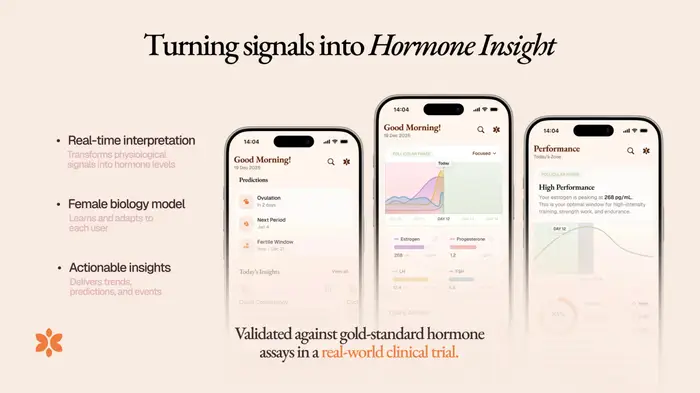
One app screen in the fundraising deck says estrogen is peaking at 268 pg/mL. Beneath the screens: “Validated against gold-standard hormone assays in a real-world clinical trial.” That is a concentration and a clinical-validation claim. Hormone-aware wellness is no longer doing all the talking.
The slide provides no trial identifier, participant count, hardware version, or hormone-by-hormone error results. It does not establish that the concentration was independently tested on the device customers will receive. It does not show how far predictions missed the reference assays. The curve looks finished. The evidence needed to check it is absent from the slide.
These are publicly released, redacted slides. They do not establish what investors saw privately. They do establish the public claim. Compare it with the FAQ’s narrower phase-classification result: 94.1% phase accuracy does not establish the accuracy of 268 pg/mL.
Clair put the number on the screen. Put the error next to it.