Generating a hormone number and proving it reliable are different accomplishments. Clair advertised the capability while planning the work needed to validate it.
First, admire the bracelet.
Clair has the presentation down. Wear a wristband. Collect more than 130 biomarkers. Add machine learning. Finally understand your hormones. The website looks expensive. The biomarker count sounds impressive. I went looking for the part where those signals become reliable hormone readings.
The starting observation is real: hormones affect the body, and wearable sensors can detect some of those effects. That gets Clair as far as a research premise. A changed signal does not identify its cause or calculate a hormone concentration. The entire product depends on showing that Clair can work backward from those signals to a reliable answer for an individual woman.
A long sensor list fills a product page. The missing step is evidence that the answer is right.
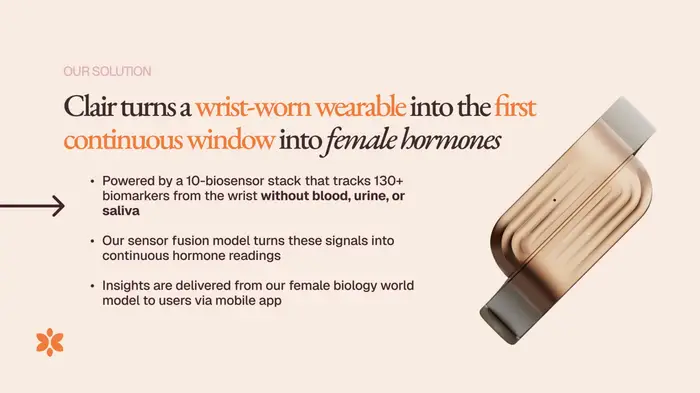
The fundraising deck promises a 10-biosensor stack tracking 130+ biomarkers and a sensor-fusion model that turns them into continuous hormone readings, without blood, urine, or saliva. Clair chose to advertise hormone readings. Now publish the results that claim requires.
The capability exists. The validation is coming.
The archived February FAQ advertised cycle-phase classification, LH-surge detection, hormonal trends, and eventual numerical estimates for estradiol, progesterone, LH, and FSH. On estimating concentrations, it declared: “This capability exists today.” A little farther down: “The staging is regulatory, not technical.” Apparently, the difficult part was finished.
Then I read the roadmap. Clair 1.0 would launch as a general-wellness device. Clair 2.0 would pursue FDA clearance and unlock quantitative hormone reporting on the same hardware through a free software upgrade. A three-phase clinical program would generate the large paired dataset needed to validate that reporting at clinical grade. The capability was ready for the headline. The evidence was still on the schedule.
Clair says it has trained models against paired wearable and hormone measurements. Fine. Publish what those models demonstrated. Producing a number is easy to claim; establishing that a woman can rely on it requires results. Calling the remaining work regulatory does not supply those results. Neither does a phase-classification score.
A software update can put a hormone number on a screen. An announcement cannot make it accurate.
Now read the terms.
The current terms describe a general-wellness product. They exclude medical diagnosis, contraception, and use as the sole basis for fertility planning. That is a substantial set of exclusions for a pitch built around understanding reproductive health. Read them before buying the impression the homepage creates.
The pitch introduces a system that understands hormonal biology. The reader gets to assemble the restrictions: what was tested, what belongs to a later version, and what the company says not to rely on. Those distinctions belong beside the promise. Understanding the sales pitch takes seconds. Understanding its limits takes homework.
Clair does not get credit for the broadest impression of its technology while answering only for the narrowest reading of its terms. Put the actual result beside the advertised capability. Let the two face each other.