Count the participants. Identify the hardware. Name the task. Clair’s largest numbers still do not establish the production wearable’s accuracy.
Count the women.
The January essay and February FAQ describe more than 5,000 days of physiological data. The prototype account covers more than 40 women and 127 complete menstrual cycles. Three impressive-looking numbers. One claimed body of research. Another day from the same woman does not add another participant.
The FAQ says the 94.1% phase-classification score came from leave-one-subject-out cross-validation. That holds out a person, rather than another cycle from someone already seen by the model. Clair also describes paired hormone testing. Those are useful methodological claims. They are not the full study. Publish the detailed results, the analysis needed to reproduce them, and the failures hidden by the average.
The fine print changes the product.
The same FAQ reports 95.2% accuracy for regular cycles and 84.3% for irregular cycles. The initial validation excluded people using hormonal contraception or hormone replacement therapy. The headline comes with conditions. For someone trying to understand an irregular cycle, the better number is the wrong one to emphasize.
The hardware changed too. Clair’s January essay says the sensor stack changed substantially after the prototype. Its reported result concerns an earlier configuration; its customers are being sold a later device. Better hardware could improve performance. Changed inputs could also require retesting. The old percentage does not follow the company name into a new bracelet.
Identify the participants, hardware, and claims actually tested. Show the data separation, uncertainty, and failures. The linked materials contain enough detail to expose these gaps. They do not contain the full report needed to resolve them.
The deck’s clinical-validation caption leaves the same hole. It claims validation against gold-standard assays without identifying the tested hardware or supplying results. “Validated” needs an object: a particular device, performing a particular task, for particular users. The slide leaves the reader to join a prototype result to a production promise. It does not establish that connection.
The Mayo name does not supply the result.
Clair’s current FAQ says its models are trained on deidentified clinical records from more than 100,000 women through its Mayo partnership. An impressive number. A different kind of evidence. Training on clinical records is not a trial of 100,000 women wearing Clair’s final device while researchers compare its output with paired hormone tests.
Mayo confirms the accelerator relationship. Its announcement contains no completed evaluation of Clair’s wearable accuracy. Clair’s own FAQ says studies to train and validate the production hardware are launching. Launching describes work getting started. It supplies no completed result.
The affiliation is documented. Now document the product’s performance: reference tests, errors, and failure cases. A prestigious institution’s name cannot wear the bracelet for the participants.
The high bar leads to a Google Form.
The current FAQ invokes Mayo, Stanford, and clinical evidence, then offers “Join a research study.” The link leads to a Google Form titled “Clair Health Research Interest Form.” The invitation advertises a study. The destination collects interest.
The introduction describes possible contact about future research if a suitable study comes up. It collects contact details, age, and location. The public question list also asks about diagnoses, cycle regularity, and hormonal medications. This is a health-background intake for prospective participants.
It is not enrollment in a particular study. Yet it asks for identifiable health information without explaining who can access the answers or how long they are retained. A promise of confidentiality leaves both questions unanswered.
Google Forms can be used in legitimate research under appropriate institutional rules. The platform is not the finding. The mismatch is: “Join a research study” leads to an interest registry. Label the invitation accurately. Explain the data handling before collecting someone’s health history.
Clair’s poster. Somebody else’s recordings.
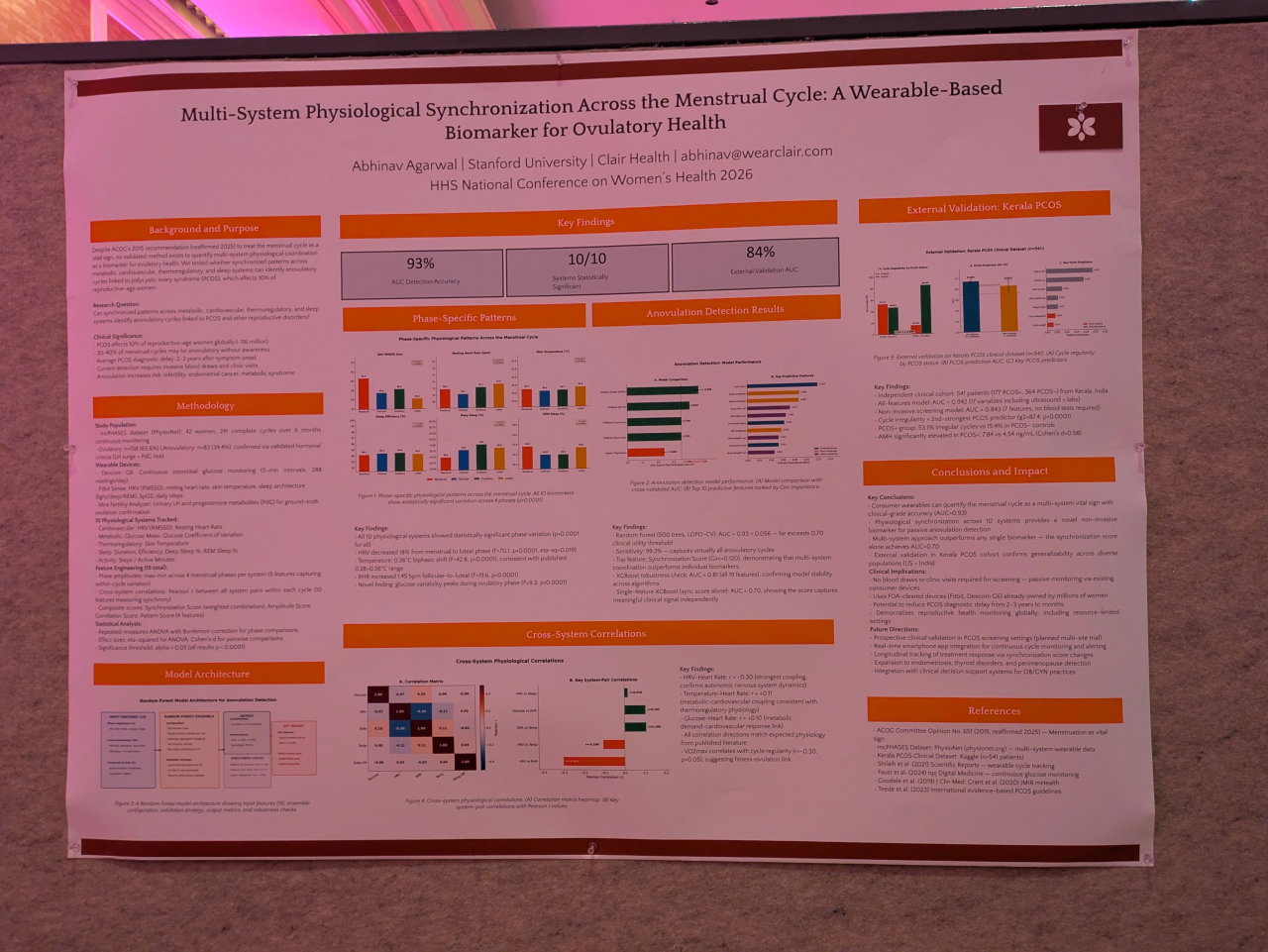
A reader pointed me to the small print on Abhinav Agarwal’s poster. I checked the original photograph in the evidence folder. The methodology names “mcPHASES dataset (PhysioNet).” It lists Fitbit Sense, Dexcom G6, and a Mira fertility analyzer. No Clair bracelet appears in the methods.
PhysioNet hosts research datasets. The mcPHASES record was published in September 2025. Its Scientific Data paper names five authors, all affiliated with the University of Toronto’s Department of Computer Science. Neither Clair cofounder is in that byline. The paper describes data collection in 2022 and 2024. These recordings came from that research project. They were not collected from people wearing Clair’s bracelet.
The poster credits the external dataset. Researchers can legitimately reuse existing data for a new analysis. Calling that analysis evidence of what a different bracelet can do requires another step. Clair has to validate its hardware. Printing its name above an analysis of Fitbit recordings does not perform that test.
Separate the results from reused data from the results obtained with Clair hardware. Publish the evidence connecting them. The poster supplies no such bridge.
| Role in the analysis | Named source or device |
|---|---|
| Underlying dataset | mcPHASES, hosted by PhysioNet |
| Wearable physiology | Fitbit Sense |
| Glucose measurements | Dexcom G6 |
| Hormonal reference for ovulation | Mira urine testing: LH and PdG |
| Clair bracelet | Not listed in the poster’s methods |
The cycle counts do not reconcile themselves.
The poster reports 42 women and 241 complete cycles over six months of continuous monitoring. The dataset documentation is more specific: 42 participants’ first-interval records were released; 20 returned for a second three-month interval two years later. That does not describe 42 women continuously monitored for six months.
The cycle totals also differ. The dataset paper reports 192 complete cycles, defined by a sequence containing all four phases. The poster reports 241. Different definitions or processing could explain the difference. The poster does not reconcile it. Publish the inclusion rules and analysis code. A cycle count should be traceable to the cycles actually counted.
A detection score is not a hormone error report.
The poster’s main model detects anovulation. It reports an AUC of 0.93 ± 0.056 using LOPO cross-validation. The headline calls this “93% AUC Detection Accuracy.” AUC and the percentage of predictions that are correct are different measures. Neither supplies the error in an estrogen concentration displayed by Clair’s bracelet.
A separate Kerala panel classifies PCOS using another existing dataset, identified in the references as a Kaggle clinical dataset. It reports an AUC of 0.843 for a seven-feature model. Different records. Different task. Still no trial of Clair’s production wearable.
Do not merge this poster with the archived 94.1% cycle-phase claim. The tasks and cycle counts differ, and the reviewed documents do not establish that they use the same analysis. This finding identifies the source of this poster’s data, not every result Clair has advertised. For the product being sold, the demand is unchanged: test the actual bracelet against the claimed hormone outputs. Publish the errors.
Sources for this chapter
The Data Was Always There (opens in a new tab)
How It Works: Your Questions, Answered (opens in a new tab)
Clair fundraising slide — Hormone app screens / validation claim (opens in a new tab)
Clair Health — current FAQ (opens in a new tab)
Clair Health Research Interest Form (opens in a new tab)
UW–Madison HRPP — Preparing Supporting Documents (opens in a new tab)
Abhinav Agarwal / Clair Health — menstrual-cycle research poster (opens in a new tab)
PhysioNet — mcPHASES, version 1.0.0 (opens in a new tab)
Lin et al. — mcPHASES dataset paper, Scientific Data (opens in a new tab)